


Externalities are firms’ uncompensated cost or benefits to society and the environment.
A fundamental concept in economic science, they are the foundation of several economic disciplines. In a sense externalities are the economic definition of sustainability.
Externalities are firms’ uncompensated cost or benefits to society and the environment. A fundamental concept in economic science, they are the foundation of several economic disciplines. In a sense externalities are the economic definition of sustainability.
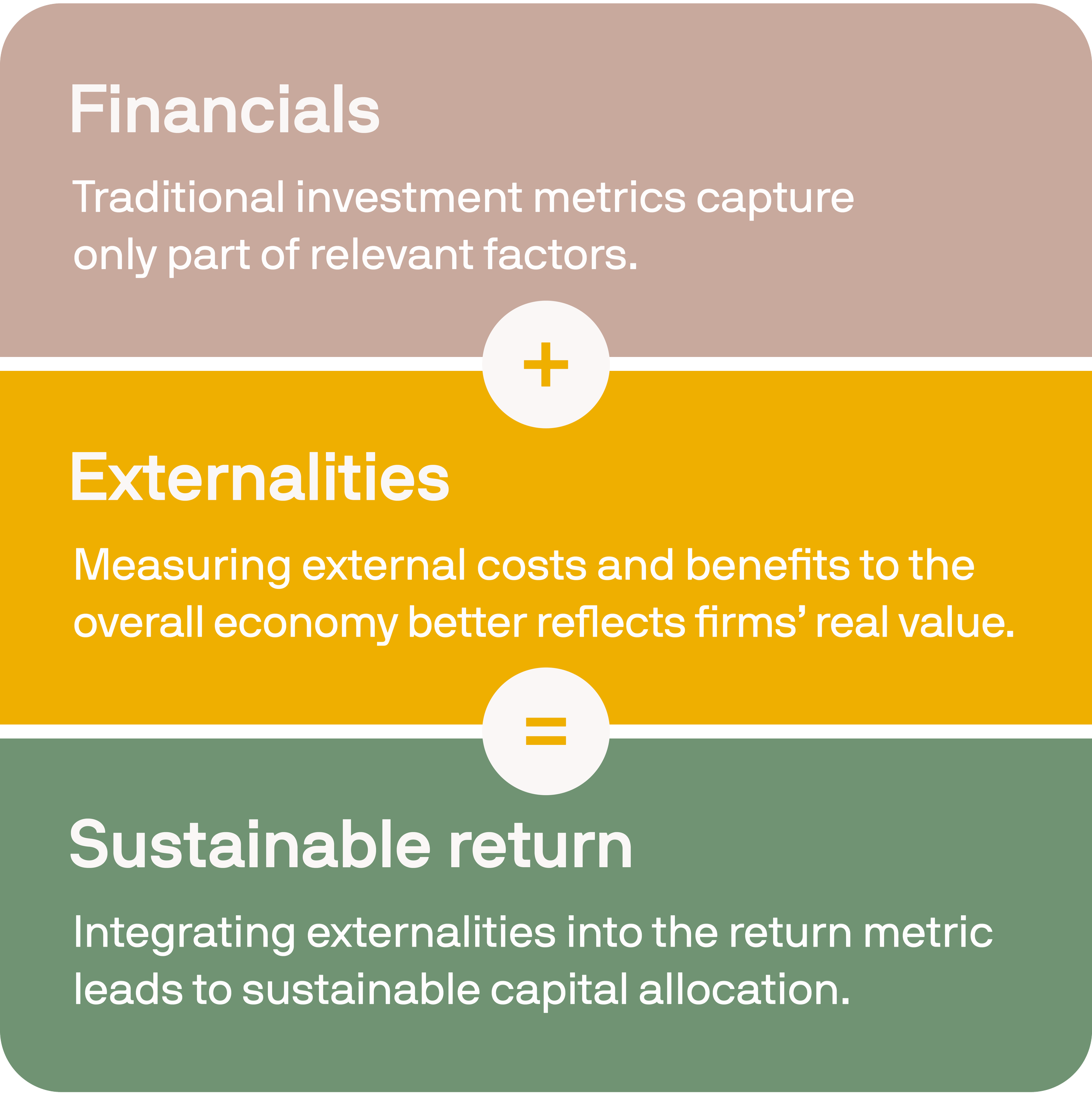
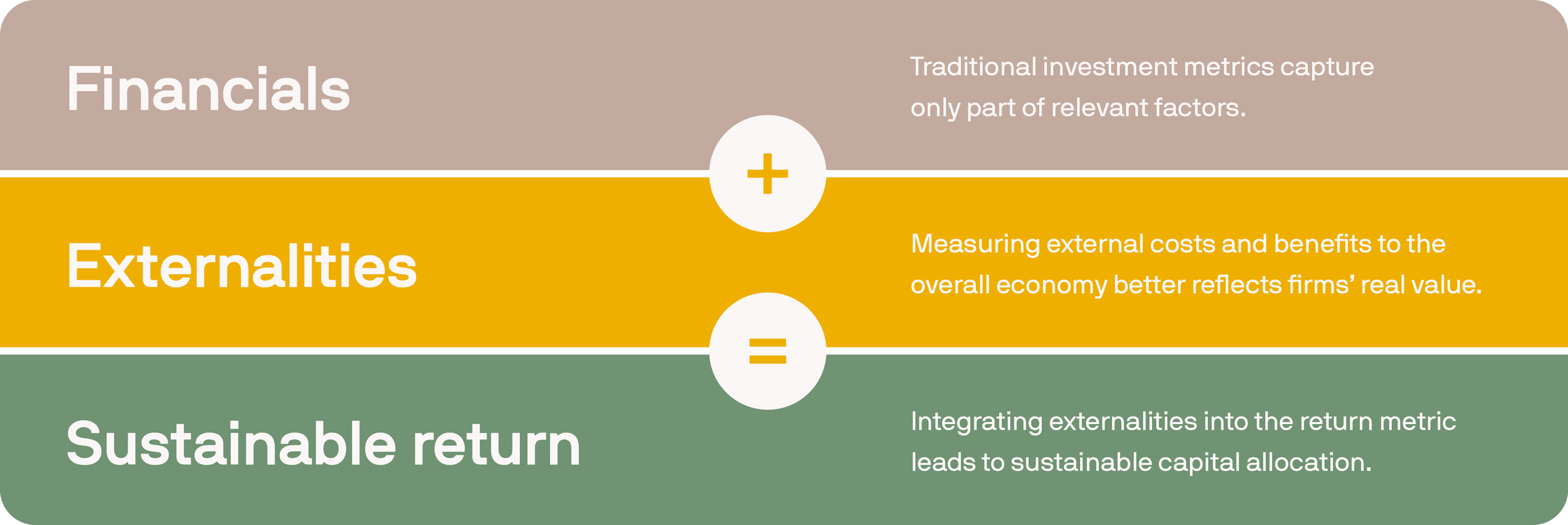
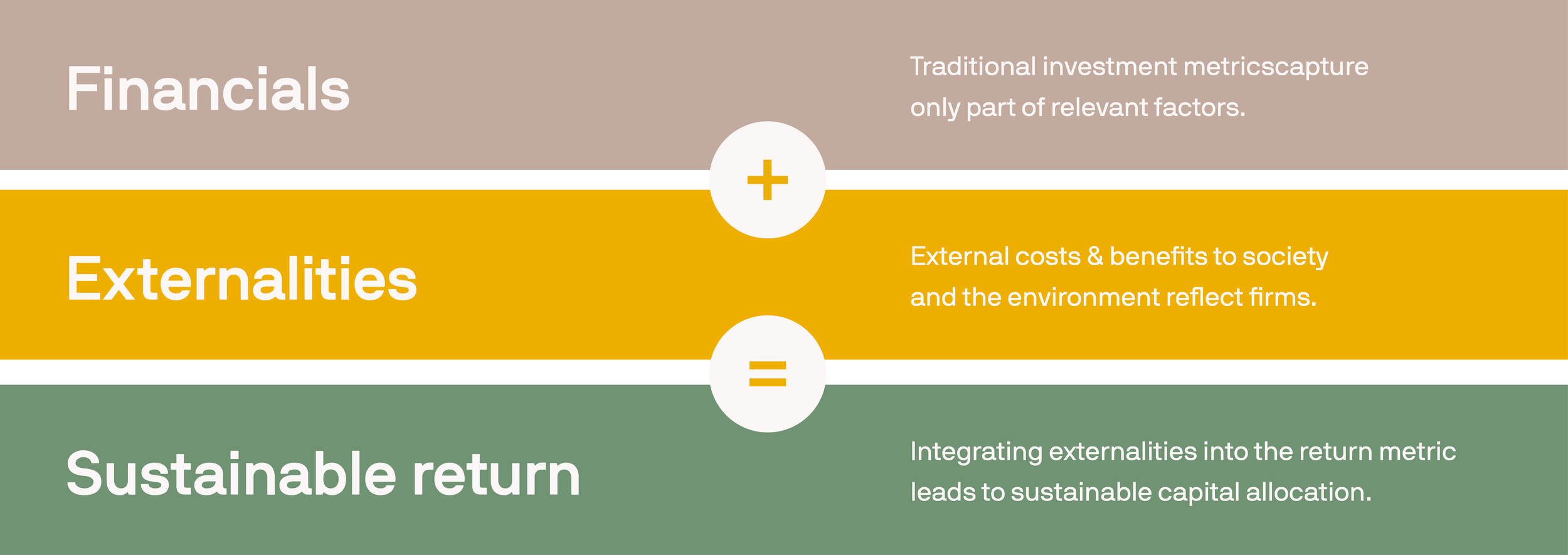
Managing externalities is key for the overall efficiency of the economy, so that all resources including human, natural and social capital are used optimally. Investment strategies built on externalities select firms that create long-term value, as externalities are internalized over time.
-
An externality or external effect is an uncompensated cost or benefit to an uninvolved third party that arises due to other economic agents’ activities.
A prominent example for a negative externality is air pollution, and more generally, environmental damages. An example for a positive externality is the creation of knowledge.
-
Externalities are estimated as the damages or benefits, in monetary terms, to society and environment. They are calculated by measuring a physical impact driver, such as greenhouse gas emissions, and multiplying by a monetary valuation factor.
-
Sustainable return is the key metric of sustainable investing. It corrects traditional, financial return by the externalities associated with the investment.
-
The theory of externalities is a foundation of public economics and environmental economics. Since decades, governments and NGOs use externalities to assess the environmental and societal impacts of proposed legislation, regulations and public projects.
-
Taking into account externalities is the essence of long-term and sustainable investing. Significant externalities are likely to attract government attention, e.g. taxation, or product market reaction, e.g. consumer activism, with associated effects on future cash flows and security prices.